X
Changing a filter automatically updates the other available filters.
Kimi Antonelli and the Comeback of Dreams: Monza 2026
10 September 2026
In Formula 1, some victories are worth more than the points they bring, while others can define an entire season.
And then there are those rare wins that become part of the sport’s history.
The 2026 Italian Grand Prix was undoubtedly one of them.
At Monza, in front of a raucous home crowd, Kimi Antonelli was the star of a stunning drive to turn a 19th-place start into a victory that will be remembered for years to come.
The Bologna-born Mercedes driver claimed his home win after a breathtaking charge through the field, completing the comeback with a decisive pass on teammate George Russell in the closing stages.
But Antonelli’s triumph was about far more than personal redemption after the disappointment of the previous year. It also ended a 60-year wait for an Italian winner at Monza.
Let’s take a lap-by-lap look at how this extraordinary victory unfolded.
From 19th to the Top Step
Before the lights went out, the odds were firmly stacked against Antonelli.
A grid penalty linked to the introduction of new power-unit components had left him starting all the way down in 19th.
But it quickly became clear that his race pace was something special.
From the opening laps, Antonelli began carving his way through the field. Overtake after overtake, the seemingly impossible comeback started to look increasingly realistic, until what had initially been a damage-limitation exercise turned into a genuine fight for victory.
Starting from 19th at Monza is never straightforward. There is traffic everywhere, slower cars can cost valuable time, and the further back you start, the greater the risk of getting caught up in someone else’s incident.
Under normal circumstances, simply limiting the damage would have been the sensible approach.
Antonelli had other ideas.
The race was turned on its head early on, with several pivotal moments shaping the outcome. One of the biggest came on Lap 2, when Charles Leclerc’s crash triggered a red flag.
The restart reshuffled the order and gave drivers further down the field a fresh opportunity to close the gap to the leaders. Antonelli seized it. From that point on, the comeback gathered momentum.
What could have been a routine recovery drive gradually became something far more ambitious.
The numbers tell the story in its simplest form:
19th → 1st.
Behind those two numbers lies one of the most remarkable performances of Antonelli’s young career.
The Mercedes driver made his way through a huge number of rivals, picking his moments carefully and steadily working his way towards the front.
According to the post-race statistics, Antonelli made 26 overtakes. That number alone underlines just how extraordinary his drive was.
At Monza, though, raw speed is only part of the equation. To recover that many places, a driver needs to know when to attack and when to bide their time. Tyre management matters. Energy deployment matters. Avoiding unnecessary contact matters.
And above all, so does keeping a cool head.
Starting from the back can turn a Grand Prix into an endless succession of battles, with very little room for error.
Antonelli never appeared overwhelmed by the pressure.
Instead, he built his race one move at a time, picking off his rivals and steadily climbing the order.
And when he finally reached the sharp end of the field, he had something else waiting in reserve: the pace to fight for the win.
Mercedes and the Battle with Russell
The defining chapter of the race came when Antonelli caught his teammate.
George Russell had started on the front row and had been a fixture at the front for much of the race. He had put himself in the perfect position to fight for victory and, for a long time, looked like the man most likely to take the chequered flag first.
But Antonelli was closing fast. The battle between the two Mercedes drivers carried an added layer of significance because Russell was Antonelli’s closest challenger in the championship.
Every point therefore mattered twice: Antonelli could extend his own lead while simultaneously taking points away from his main rival.
The turning point came during the Virtual Safety Car.
Mercedes brought Antonelli into the pits for a fresh set of tyres, while Russell stayed out on older rubber. It was a gamble that completely changed the complexion of the race. From there, Antonelli began eating into the gap lap after lap until he was right on Russell’s gearbox. With only a handful of laps remaining, the win was suddenly within touching distance.
The two Mercedes cars went head-to-head, with neither driver willing to give an inch. Eventually, Antonelli found the opening he needed. The Italian made the decisive move in the closing stages, completing the pass and taking the lead with just a few laps left.
Russell fought back, but his increasingly worn tyres left him with little answer. He had to settle for second, while Max Verstappen brought his Red Bull home in third.
After 53 laps of flat-out racing, Mercedes’ No. 12 crossed the line first.
Kimi Antonelli had won the Italian Grand Prix.
And he had done it in spectacular fashion.
Sixty Years After Scarfiotti
So, why did Antonelli’s Monza victory mean so much?
To understand that, you have to look back through the history of Italian Formula 1.
The last Italian driver to win the Italian Grand Prix at Monza was Ludovico Scarfiotti, who triumphed for Ferrari in 1966.
For six decades, generation after generation of Italian drivers had tried and failed to repeat the feat. Until Antonelli.
For many of the fans celebrating in the grandstands was something they had never experienced before.
At just 20 years old, the Bologna-born driver became the youngest Italian to win his home Grand Prix, ending a wait that had lasted an entire lifetime for some fans. And he did it from 19th on the grid. That makes the achievement even more extraordinary.
There was also a deeply personal element to the victory. Monza is unlike any other circuit on the Formula 1 calendar.
It is one of the fastest tracks in the world, surrounded by the trees of Monza Park, but its real magic comes from the atmosphere.
This is a place where Italian fans do not simply watch Formula 1. They live it.
Every overtake from an Italian driver is met with a louder roar from the grandstands. Every position gained feeds the belief that something special might be happening. For Antonelli, this was never going to be just another race. It was his home race. It was Monza.
And it was the same circuit where, in 2025, he had finished only ninth — a disappointing result after the high expectations generated by his performances earlier in the season. Twelve months later, the same track witnessed one of the biggest achievements of his career.
Mercedes boss Toto Wolff himself highlighted the contrast between that difficult weekend and Antonelli’s 2026 triumph.
The symbolism was hard to miss. A year earlier, the pressure was about avoiding mistakes. This time, Antonelli returned to Monza as one of the leading figures in Formula 1 — and left as its hero. That is why his victory immediately took on a significance far beyond the paddock.
Antonelli became the first Italian to win at Monza since 1966 and claimed the 50th Formula 1 victory by an Italian driver.
More importantly, he extended his championship lead over Russell to 66 points after 13 rounds.
Monza was not just the race of the heart.
It was also a hugely important race for the championship.
More Than Raw Speed
When people talk about young drivers, the first thing they usually mention is outright pace. Antonelli has never been short of that.
Monza showed another side of his talent: his ability to manage a race.
Being fast over one lap is one thing. Managing a 53-lap Grand Prix, while fighting through traffic, looking after the tyres, managing energy and making split-second decisions under pressure, is something else entirely. A driver can be lightning-fast in qualifying and struggle on race day. They can attack too aggressively and destroy their tyres. They can have the pace to win but lose everything with one mistake when the pressure is at its highest.
Antonelli put all the pieces together at Monza.
He came from the back of the grid.
He gained 18 positions.
He made 26 overtakes.
He knew when to attack.
He knew when to wait.
He made the strategy work in his favour.
He beat his teammate.
He delivered in front of his home crowd.
He ended Italy’s 60-year wait for a Monza winner.
And he strengthened his championship lead.
Most importantly, he avoided the biggest trap facing a driver starting from the back: trying to win the race in the first few laps.
The most impressive part, however, may not be any of those statistics. It is what Antonelli’s performance felt like when the chequered flag finally fell. It felt like a turning point. Antonelli is no longer simply the promising young Italian everyone has been talking about.
He is now a driver the rest of the field has to beat. A driver they have to take seriously. And perhaps that is the real significance of Monza.
A Race That Changed the Perception of Antonelli
Before Monza, Antonelli was already regarded as one of Formula 1’s most exciting young talents. After Monza, that perception changed. There is a world of difference between being tipped as a potential future champion and actually proving you can win a race of this magnitude from 19th on the grid, in front of your home crowd, while beating your teammate and championship rival.
The victory also raised Antonelli’s profile internationally. The performance was widely hailed as one of the standout drives of recent Formula 1 history — and it is easy to see why. Comeback victories from the back of the grid are incredibly rare in Formula 1.
Naturally, comparisons with the greats of the past have already begun. But those comparisons should be treated with caution. Antonelli’s career is still in its early stages, and his story is far from finished. What can already be said, however, is that his trajectory is remarkable.
He has shown that he can win.
He has shown that he can handle pressure.
He has shown that he can fight through the field.
He has shown that he can beat his teammate.
And, perhaps most importantly, he has shown that he can turn a seemingly hopeless situation into a victory.
Those are precisely the qualities required to become a Formula 1 World Champion.
The Italian Crowd and the Tears on the Podium
For Antonelli — and for the fans watching — the most emotional moment came after the race.
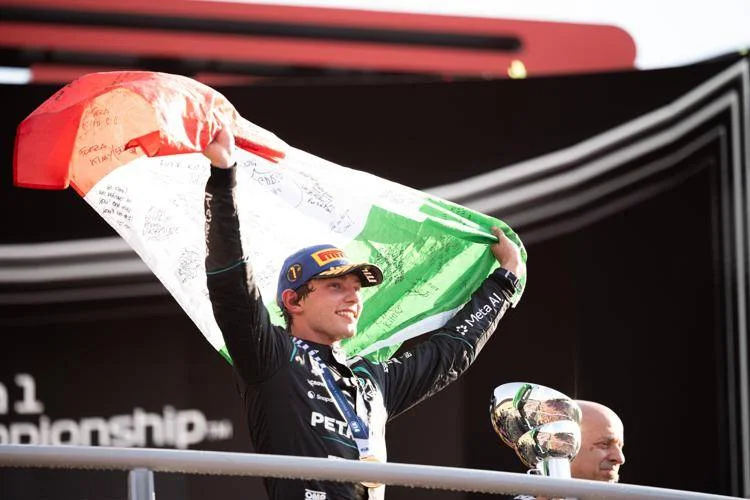
On the podium, the young Mercedes driver celebrated in front of his home crowd with the Italian tricolour draped over his shoulders. The images of Antonelli visibly overcome with emotion said more than any statistic ever could. After a race like that, there was no keeping the emotions in check. And the Monza crowd delivered everything it had promised. Every overtake had fuelled the dream.
Every position gained had made the grandstands louder. Then Antonelli crossed the finish line. The dream became reality.
The boy from Bologna who had grown up dreaming of Formula 1 was standing on the top step of the Monza podium.
And in front of him was a sea of Italian fans.
The Victory That Could Shape the Championship
From a championship perspective, the timing of the victory could hardly have been better. Antonelli claimed his seventh win of the season and stretched his lead over Russell to 66 points. That is a substantial advantage, but it is far from decisive.
Formula 1 has a habit of changing everything in the space of a single weekend. A retirement, a technical failure, a penalty or simply a bad day at the office can transform the championship picture in an instant. Antonelli himself remained measured after the race, stressing that the season is still long and that the focus has to remain on taking things one race — and one lap — at a time.
That is probably exactly the right mentality. You do not win a World Championship at Monza. But some races can change the entire complexion of a season.
Monza 2026 was certainly one of them.
From Monza to a Possible World Championship
So here comes the inevitable question: Can Kimi Antonelli become World Champion?
It is obviously too early to start celebrating, but the signs are certainly encouraging. At just 20, the Mercedes driver leads the championship and has already shown an ability to handle situations that would test even much more experienced drivers.
His advantage over Russell is significant, while Mercedes has a car capable of fighting at the front. Antonelli also appears to be improving at remarkable speed. If he can maintain this trajectory, he could even challenge Sebastian Vettel’s record as the youngest Formula 1 World Champion.
But a championship is not won with one spectacular afternoon. It requires consistency. That will be Antonelli’s next challenge.
After the euphoria of Monza, he must now reproduce the same level of focus and execution over the races still to come.
Winning an extraordinary Grand Prix is difficult.
Winning a World Championship is something else entirely.
The Future Starts Here
Formula 1 does not give drivers much time to celebrate. Monza is already in the rear-view mirror. There will be new circuits, new strategies, new battles and new opportunities. And Antonelli will now have to deal with an entirely different kind of pressure: that of being the championship leader in the final stages of the season. Russell will keep chasing. Verstappen and the other contenders will look for a way into the fight. And Mercedes will have to remain competitive enough to support the title ambitions of both of its drivers.
Whatever happens between now and the end of the season, one thing is already certain. On September 6, 2026, Kimi Antonelli wrote his name into the history of the Italian Grand Prix.
He started 19th.
He had an entire grid of rivals ahead of him.
He turned a penalty into motivation.
He fought his way through the field.
He overtook.
He held his nerve.
And, in the end, he saw the chequered flag before anyone else.
After 60 years, an Italian had won at Monza again. And it was a 20-year-old from Bologna who looks destined to have a huge future in Formula 1. A new chapter in Italy’s Formula 1 story had begun. It started with an almost impossible comeback and ended with the tricolour draped over Antonelli’s shoulders. And if the 2026 World Championship ultimately ends up in his hands, there is one place everyone will remember as the moment he made his first decisive move towards the title.
The heart of Brianza, in front of an Italian crowd that had waited 60 years for this moment.
Edited by Elena Garzilli
And then there are those rare wins that become part of the sport’s history.
The 2026 Italian Grand Prix was undoubtedly one of them.
At Monza, in front of a raucous home crowd, Kimi Antonelli was the star of a stunning drive to turn a 19th-place start into a victory that will be remembered for years to come.
The Bologna-born Mercedes driver claimed his home win after a breathtaking charge through the field, completing the comeback with a decisive pass on teammate George Russell in the closing stages.
But Antonelli’s triumph was about far more than personal redemption after the disappointment of the previous year. It also ended a 60-year wait for an Italian winner at Monza.
Let’s take a lap-by-lap look at how this extraordinary victory unfolded.
From 19th to the Top Step
Before the lights went out, the odds were firmly stacked against Antonelli.
A grid penalty linked to the introduction of new power-unit components had left him starting all the way down in 19th.
But it quickly became clear that his race pace was something special.
From the opening laps, Antonelli began carving his way through the field. Overtake after overtake, the seemingly impossible comeback started to look increasingly realistic, until what had initially been a damage-limitation exercise turned into a genuine fight for victory.
Starting from 19th at Monza is never straightforward. There is traffic everywhere, slower cars can cost valuable time, and the further back you start, the greater the risk of getting caught up in someone else’s incident.
Under normal circumstances, simply limiting the damage would have been the sensible approach.
Antonelli had other ideas.
The race was turned on its head early on, with several pivotal moments shaping the outcome. One of the biggest came on Lap 2, when Charles Leclerc’s crash triggered a red flag.
The restart reshuffled the order and gave drivers further down the field a fresh opportunity to close the gap to the leaders. Antonelli seized it. From that point on, the comeback gathered momentum.
What could have been a routine recovery drive gradually became something far more ambitious.
The numbers tell the story in its simplest form:
19th → 1st.
Behind those two numbers lies one of the most remarkable performances of Antonelli’s young career.
The Mercedes driver made his way through a huge number of rivals, picking his moments carefully and steadily working his way towards the front.
According to the post-race statistics, Antonelli made 26 overtakes. That number alone underlines just how extraordinary his drive was.
At Monza, though, raw speed is only part of the equation. To recover that many places, a driver needs to know when to attack and when to bide their time. Tyre management matters. Energy deployment matters. Avoiding unnecessary contact matters.
And above all, so does keeping a cool head.
Starting from the back can turn a Grand Prix into an endless succession of battles, with very little room for error.
Antonelli never appeared overwhelmed by the pressure.
Instead, he built his race one move at a time, picking off his rivals and steadily climbing the order.
And when he finally reached the sharp end of the field, he had something else waiting in reserve: the pace to fight for the win.
Mercedes and the Battle with Russell
The defining chapter of the race came when Antonelli caught his teammate.
George Russell had started on the front row and had been a fixture at the front for much of the race. He had put himself in the perfect position to fight for victory and, for a long time, looked like the man most likely to take the chequered flag first.
But Antonelli was closing fast. The battle between the two Mercedes drivers carried an added layer of significance because Russell was Antonelli’s closest challenger in the championship.
Every point therefore mattered twice: Antonelli could extend his own lead while simultaneously taking points away from his main rival.
The turning point came during the Virtual Safety Car.
Mercedes brought Antonelli into the pits for a fresh set of tyres, while Russell stayed out on older rubber. It was a gamble that completely changed the complexion of the race. From there, Antonelli began eating into the gap lap after lap until he was right on Russell’s gearbox. With only a handful of laps remaining, the win was suddenly within touching distance.
The two Mercedes cars went head-to-head, with neither driver willing to give an inch. Eventually, Antonelli found the opening he needed. The Italian made the decisive move in the closing stages, completing the pass and taking the lead with just a few laps left.
Russell fought back, but his increasingly worn tyres left him with little answer. He had to settle for second, while Max Verstappen brought his Red Bull home in third.
After 53 laps of flat-out racing, Mercedes’ No. 12 crossed the line first.
Kimi Antonelli had won the Italian Grand Prix.
And he had done it in spectacular fashion.
Sixty Years After Scarfiotti
So, why did Antonelli’s Monza victory mean so much?
To understand that, you have to look back through the history of Italian Formula 1.
The last Italian driver to win the Italian Grand Prix at Monza was Ludovico Scarfiotti, who triumphed for Ferrari in 1966.
For six decades, generation after generation of Italian drivers had tried and failed to repeat the feat. Until Antonelli.
For many of the fans celebrating in the grandstands was something they had never experienced before.
At just 20 years old, the Bologna-born driver became the youngest Italian to win his home Grand Prix, ending a wait that had lasted an entire lifetime for some fans. And he did it from 19th on the grid. That makes the achievement even more extraordinary.
There was also a deeply personal element to the victory. Monza is unlike any other circuit on the Formula 1 calendar.
It is one of the fastest tracks in the world, surrounded by the trees of Monza Park, but its real magic comes from the atmosphere.
This is a place where Italian fans do not simply watch Formula 1. They live it.
Every overtake from an Italian driver is met with a louder roar from the grandstands. Every position gained feeds the belief that something special might be happening. For Antonelli, this was never going to be just another race. It was his home race. It was Monza.
And it was the same circuit where, in 2025, he had finished only ninth — a disappointing result after the high expectations generated by his performances earlier in the season. Twelve months later, the same track witnessed one of the biggest achievements of his career.
Mercedes boss Toto Wolff himself highlighted the contrast between that difficult weekend and Antonelli’s 2026 triumph.
The symbolism was hard to miss. A year earlier, the pressure was about avoiding mistakes. This time, Antonelli returned to Monza as one of the leading figures in Formula 1 — and left as its hero. That is why his victory immediately took on a significance far beyond the paddock.
Antonelli became the first Italian to win at Monza since 1966 and claimed the 50th Formula 1 victory by an Italian driver.
More importantly, he extended his championship lead over Russell to 66 points after 13 rounds.
Monza was not just the race of the heart.
It was also a hugely important race for the championship.
More Than Raw Speed
When people talk about young drivers, the first thing they usually mention is outright pace. Antonelli has never been short of that.
Monza showed another side of his talent: his ability to manage a race.
Being fast over one lap is one thing. Managing a 53-lap Grand Prix, while fighting through traffic, looking after the tyres, managing energy and making split-second decisions under pressure, is something else entirely. A driver can be lightning-fast in qualifying and struggle on race day. They can attack too aggressively and destroy their tyres. They can have the pace to win but lose everything with one mistake when the pressure is at its highest.
Antonelli put all the pieces together at Monza.
He came from the back of the grid.
He gained 18 positions.
He made 26 overtakes.
He knew when to attack.
He knew when to wait.
He made the strategy work in his favour.
He beat his teammate.
He delivered in front of his home crowd.
He ended Italy’s 60-year wait for a Monza winner.
And he strengthened his championship lead.
Most importantly, he avoided the biggest trap facing a driver starting from the back: trying to win the race in the first few laps.
The most impressive part, however, may not be any of those statistics. It is what Antonelli’s performance felt like when the chequered flag finally fell. It felt like a turning point. Antonelli is no longer simply the promising young Italian everyone has been talking about.
He is now a driver the rest of the field has to beat. A driver they have to take seriously. And perhaps that is the real significance of Monza.
A Race That Changed the Perception of Antonelli
Before Monza, Antonelli was already regarded as one of Formula 1’s most exciting young talents. After Monza, that perception changed. There is a world of difference between being tipped as a potential future champion and actually proving you can win a race of this magnitude from 19th on the grid, in front of your home crowd, while beating your teammate and championship rival.
The victory also raised Antonelli’s profile internationally. The performance was widely hailed as one of the standout drives of recent Formula 1 history — and it is easy to see why. Comeback victories from the back of the grid are incredibly rare in Formula 1.
Naturally, comparisons with the greats of the past have already begun. But those comparisons should be treated with caution. Antonelli’s career is still in its early stages, and his story is far from finished. What can already be said, however, is that his trajectory is remarkable.
He has shown that he can win.
He has shown that he can handle pressure.
He has shown that he can fight through the field.
He has shown that he can beat his teammate.
And, perhaps most importantly, he has shown that he can turn a seemingly hopeless situation into a victory.
Those are precisely the qualities required to become a Formula 1 World Champion.
The Italian Crowd and the Tears on the Podium
For Antonelli — and for the fans watching — the most emotional moment came after the race.
On the podium, the young Mercedes driver celebrated in front of his home crowd with the Italian tricolour draped over his shoulders. The images of Antonelli visibly overcome with emotion said more than any statistic ever could. After a race like that, there was no keeping the emotions in check. And the Monza crowd delivered everything it had promised. Every overtake had fuelled the dream.
Every position gained had made the grandstands louder. Then Antonelli crossed the finish line. The dream became reality.
The boy from Bologna who had grown up dreaming of Formula 1 was standing on the top step of the Monza podium.
And in front of him was a sea of Italian fans.
The Victory That Could Shape the Championship
From a championship perspective, the timing of the victory could hardly have been better. Antonelli claimed his seventh win of the season and stretched his lead over Russell to 66 points. That is a substantial advantage, but it is far from decisive.
Formula 1 has a habit of changing everything in the space of a single weekend. A retirement, a technical failure, a penalty or simply a bad day at the office can transform the championship picture in an instant. Antonelli himself remained measured after the race, stressing that the season is still long and that the focus has to remain on taking things one race — and one lap — at a time.
That is probably exactly the right mentality. You do not win a World Championship at Monza. But some races can change the entire complexion of a season.
Monza 2026 was certainly one of them.
From Monza to a Possible World Championship
So here comes the inevitable question: Can Kimi Antonelli become World Champion?
It is obviously too early to start celebrating, but the signs are certainly encouraging. At just 20, the Mercedes driver leads the championship and has already shown an ability to handle situations that would test even much more experienced drivers.
His advantage over Russell is significant, while Mercedes has a car capable of fighting at the front. Antonelli also appears to be improving at remarkable speed. If he can maintain this trajectory, he could even challenge Sebastian Vettel’s record as the youngest Formula 1 World Champion.
But a championship is not won with one spectacular afternoon. It requires consistency. That will be Antonelli’s next challenge.
After the euphoria of Monza, he must now reproduce the same level of focus and execution over the races still to come.
Winning an extraordinary Grand Prix is difficult.
Winning a World Championship is something else entirely.
The Future Starts Here
Formula 1 does not give drivers much time to celebrate. Monza is already in the rear-view mirror. There will be new circuits, new strategies, new battles and new opportunities. And Antonelli will now have to deal with an entirely different kind of pressure: that of being the championship leader in the final stages of the season. Russell will keep chasing. Verstappen and the other contenders will look for a way into the fight. And Mercedes will have to remain competitive enough to support the title ambitions of both of its drivers.
Whatever happens between now and the end of the season, one thing is already certain. On September 6, 2026, Kimi Antonelli wrote his name into the history of the Italian Grand Prix.
He started 19th.
He had an entire grid of rivals ahead of him.
He turned a penalty into motivation.
He fought his way through the field.
He overtook.
He held his nerve.
And, in the end, he saw the chequered flag before anyone else.
After 60 years, an Italian had won at Monza again. And it was a 20-year-old from Bologna who looks destined to have a huge future in Formula 1. A new chapter in Italy’s Formula 1 story had begun. It started with an almost impossible comeback and ended with the tricolour draped over Antonelli’s shoulders. And if the 2026 World Championship ultimately ends up in his hands, there is one place everyone will remember as the moment he made his first decisive move towards the title.
The heart of Brianza, in front of an Italian crowd that had waited 60 years for this moment.
Edited by Elena Garzilli
Tag Associati
Inserito in
Subscribe to our newsletter and stay always
in pole position with our latest news!
in pole position with our latest news!